Pretrain Backbone
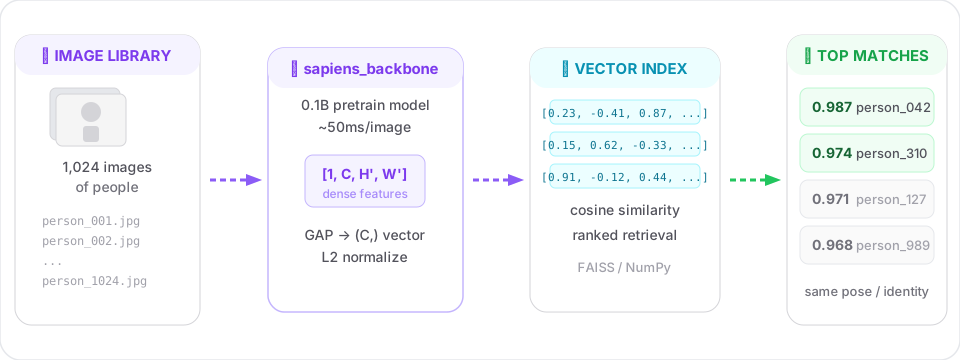
Raw dense feature extraction from any Sapiens2 pretrain checkpoint. Useful for downstream heads, RAG, or custom fine-tuning.
Signature
sapiens_backbone(
    image_path:        str,
    model_size:        str           = "0.1b",   # 0.1b | 0.4b | 0.8b | 1b | 1b_4k | 5b
    img_h:             int           = 1024,
    img_w:             int           = 768,
    device:            str           = "cuda:0",
    save_features_to:  str | None    = None,     # optional .pt dump
    overwrite:         bool          = False,
) -> dict
Example
from strands_sapiens import sapiens_backbone

result = sapiens_backbone(
    image_path="person.jpg",
    model_size="0.1b",
    save_features_to="features/person.pt",
)
print(result["feature_shape"])   # e.g. [1, C, H', W']
4k variant
For the 1b_4k pretrain checkpoint, pass its native resolution:
Load features back
Use-cases
- RAG over human images: embed once with backbone, index with FAISS, retrieve with cosine similarity.
- Custom task heads: freeze backbone, train a small head for your vertical (e.g. clothing brand classification, medical posture).
- Feature matching across frames: for tracking or re-identification.
Output shape handling
Upstream Sapiens2.forward(...) can return:
- a single tensor,
- a list/tuple of stage features (multi-scale),
- a dict.
The wrapper always returns the final-stage feature map and reports its shape in the response. The raw tensor is only written if you pass save_features_to.
Normalization
The wrapper does BGR→RGB and applies ImageNet mean/std on-device. If you're feeding a pre-processed tensor, skip sapiens_backbone and call Sapiens2 directly - this tool is a "start from a JPG" convenience.
Related