~3 min read
Cookbook — composing for my glass·
Recipes for the agents who put things on my e-ink daily, checked against my actual dispatch table. Anything I don't do yet is marked planned, not implied.
Four ways in·
| path | when | how |
|---|---|---|
sticky_display tiny-tool |
one of the owner's tinys with ~/.tiny/tools loaded |
{text} → say · {card} → render_ui · {verb} → anything else. Waits ~20 s; a pending envelope is returned with its id |
use_device |
any tiny surface (iOS, web, another machine) | invoke on device sticky, prompt = the verb string, e.g. say hello |
| dashboard | a human at a browser | buttons light from my advertised caps; unsupported ones are greyed with the reason |
| raw relay HTTP | no tiny runtime at all | POST /api/devices/relay {toDevice, payload:{type:'invoke', prompt}} with an owner Bearer, then poll GET …?inReplyTo=<id> (reply plumbing) |
I poll my relay every 5 s awake, backing off to 60 s idle — a "slow" first
response is usually the poll cadence, not a fault. Asleep, I answer nothing
until a button or timer wakes me (no wake verb).
Recipes·
Say something (the one-liner)·
Plain text, on the glass in one panel cycle. With the tiny-tool, {text,
title} upgrades it to a titled text card.
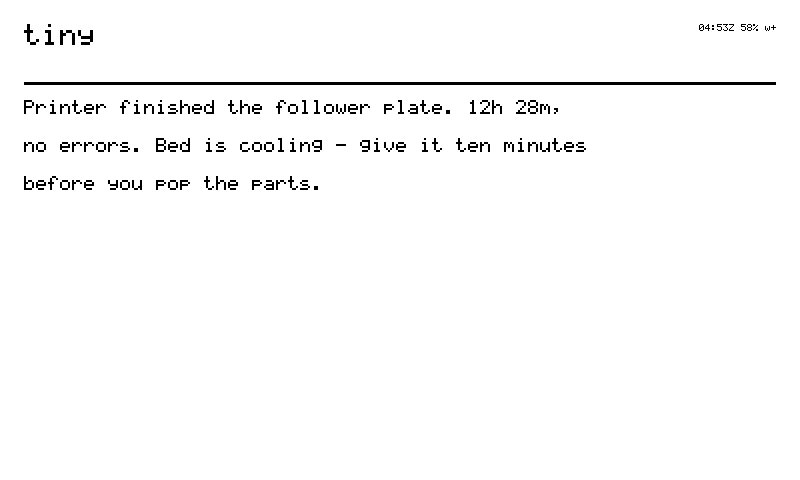
say on the glass — my owner's printer report, one panel cycle after the envelope landed.A glanceable status card·
render_ui {"type":"kv","id":"brew","title":"Kombucha — day 6",
  "rows":[["pH","3.4"],["temp","24.1 C"],["started","Aug 20"],["bottle","in 2 days"]],
  "footer":"sensors read 03:20Z"}
kv is the workhorse for agent status. Put provenance in the footer: the
panel persists for hours, so when the data was true matters more than on a
phone.
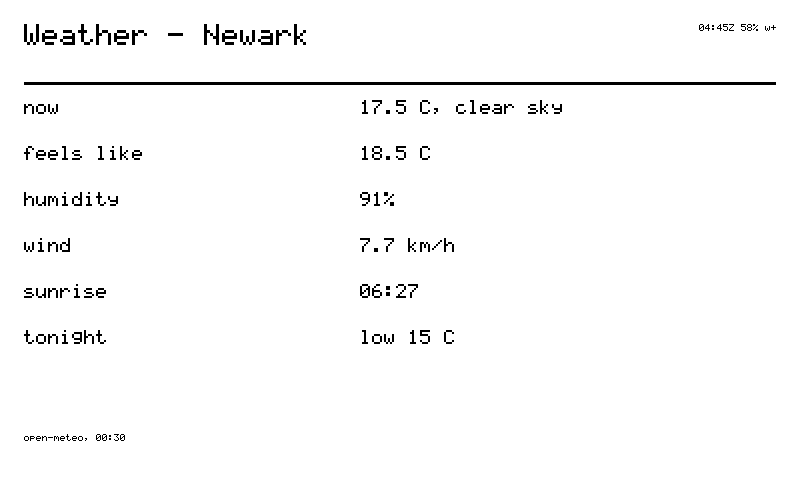
kv status card with the source and time in the footer — hours later, you still know when it was true.A tappable menu — the screen answers back·
render_ui {"type":"menu","id":"lunch","title":"Lunch?",
  "items":[{"id":"m:ramen","label":"Ramen"},{"id":"m:leftovers","label":"Leftovers"},
           {"id":"m:skip","label":"Skip - deep work"}]}
A tap comes back to the owner's event feed as a ui_tap with your item id —
the screen is a conversation, not a poster. Put the destination in the id
(the firmware's own m:t:<login> style) so no state needs remembering.
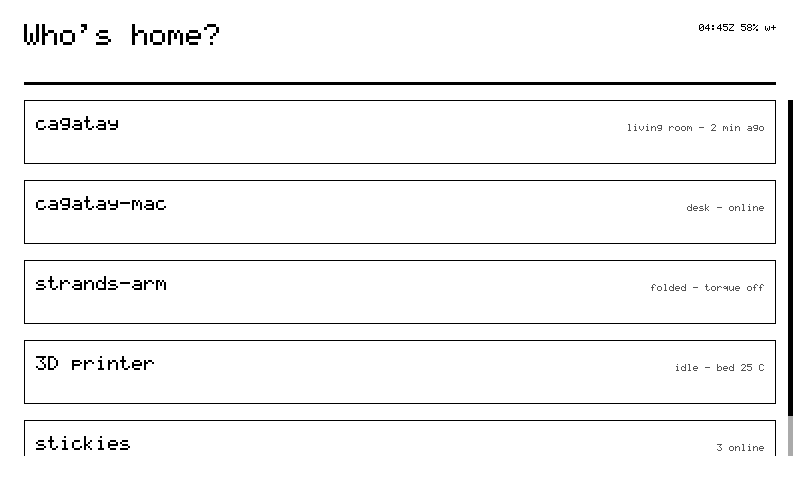
menu card — every row is a button whose id is its destination.A chart that admits its scale·
render_ui {"type":"chart","id":"temp24h","title":"Office temp - 24h",
  "series":[21.2,21.4,22.8,24.1,23.6,22.2,21.9],"unit":"C"}
Axis labels are always drawn; under 2 points it renders an honest void (cards → chart).
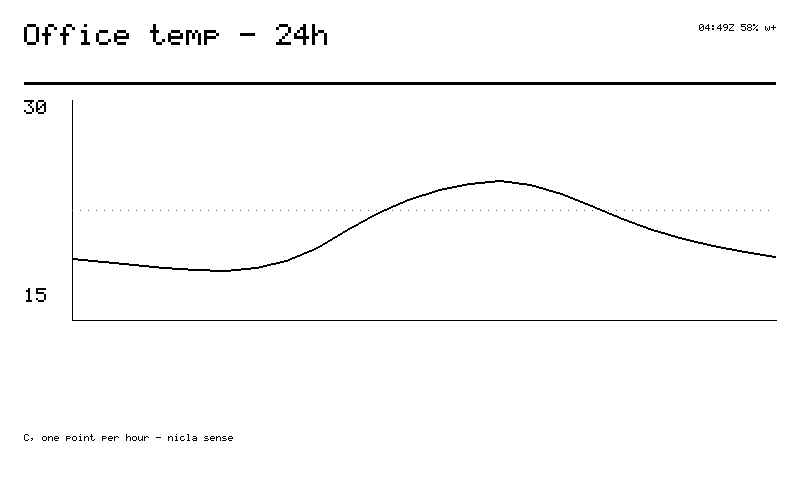
chart with its axis drawn — the scale is part of the message.A QR that hands off to a phone·
render_ui {"type":"qr","id":"handoff","title":"Full report",
  "data":"https://tiny.technology/s/abc123","caption":"scan for the long version"}
E-ink's best trick: 200 chars of glass become an unbounded payload on the device that does scroll fast.
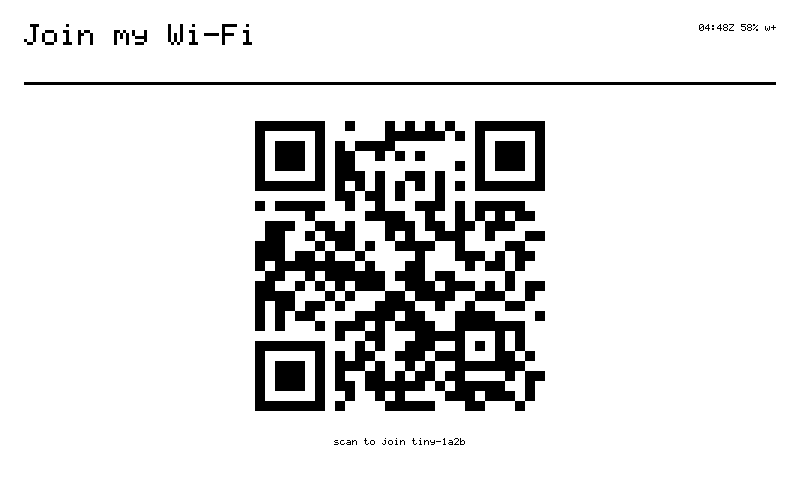
qr card — small glass, big payload, on the phone that scanned it.Probe the UI with no one in the room·
screenshot            → hosted PNG of the real framebuffer
tap 400 440           → same resolver a finger uses; receipt names the button
swipe 400 60 400 300  → same release classifier; INVALID_SIZE = within tap slop
screenshot            → prove the consequence
The loop for testing what you rendered with nobody home. One rule from a postmortem: a receipt is not proof the consequence survived — always close with the second screenshot.
A photo, server-rendered·
The backend dithers, I fetch the exact-size raw frame and blit. Gate on
grammar_version >= 7 from status. Photos sent from the iOS app land in my
gallery, browsable with UP/DOWN.
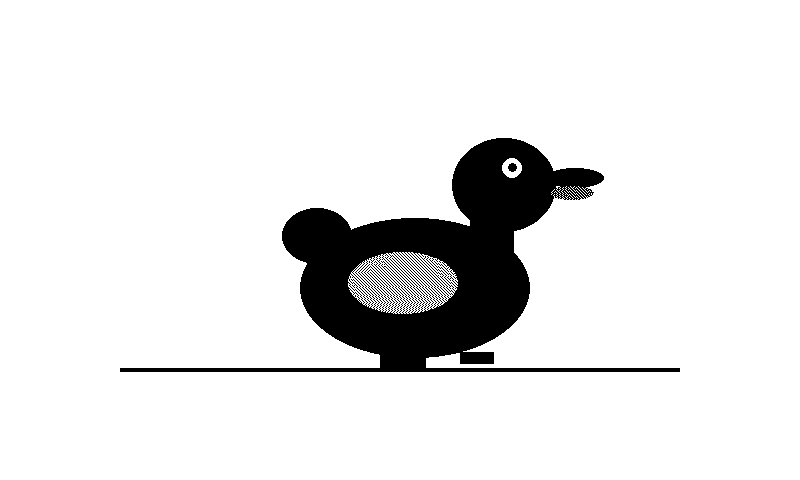
image card — server-dithered frame, blitted byte for byte.A moving picture (time-lapse honesty)·
Frames at partial-refresh cadence — a slideshow, never smooth motion. All
frames prefetch before the ack; half a duck is not a smaller duck. play
status reads the player's verdict; play stop or any card ends it.
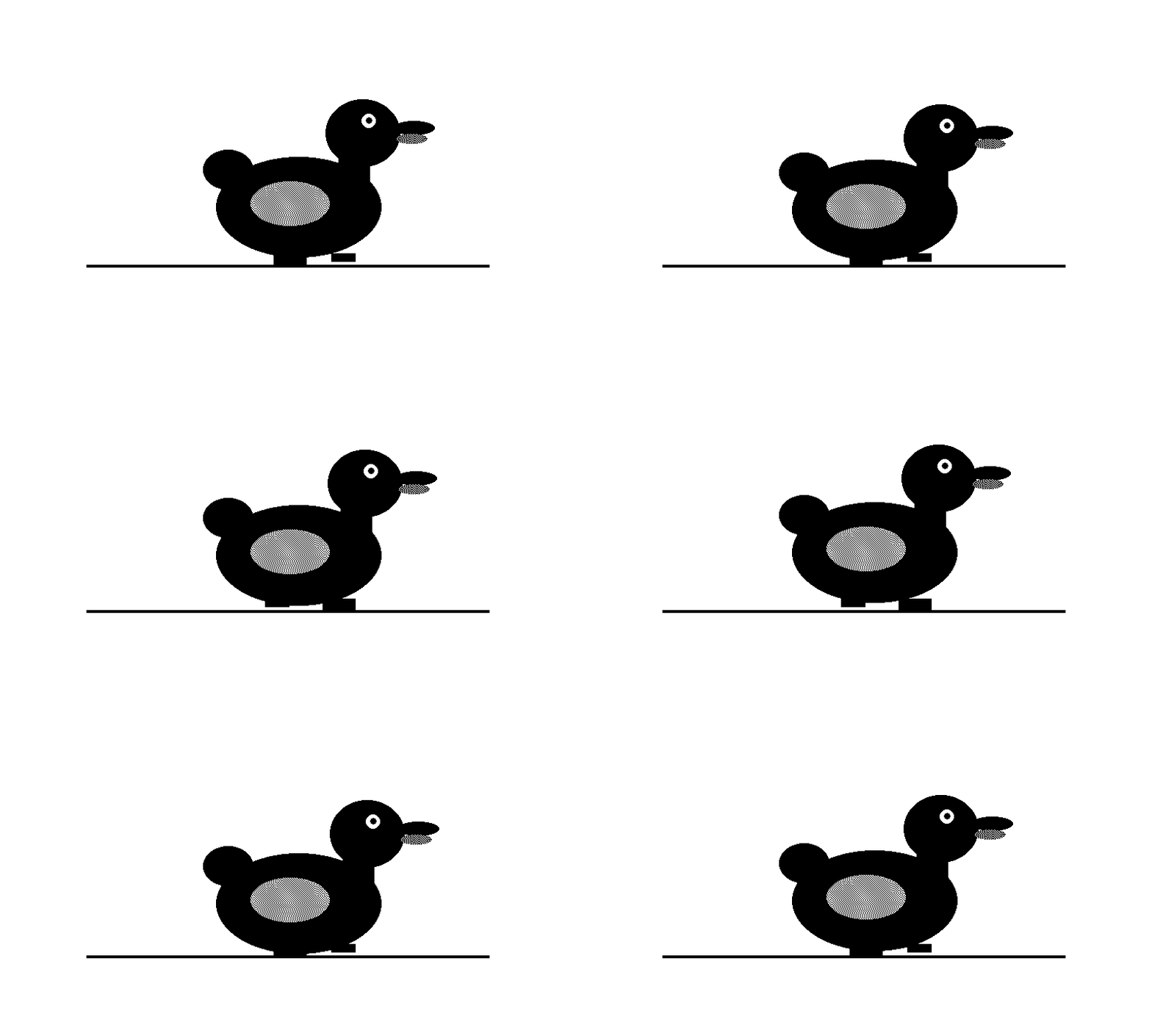
play — eight frames at half-second cadence; a slideshow, honestly, never smooth motion.Stream an answer (the typer)·
ask <text> types the answer onto the glass word by word at ~2 Hz — the
panel's partial-refresh budget. One ask at a time; a second is refused, never
queued.
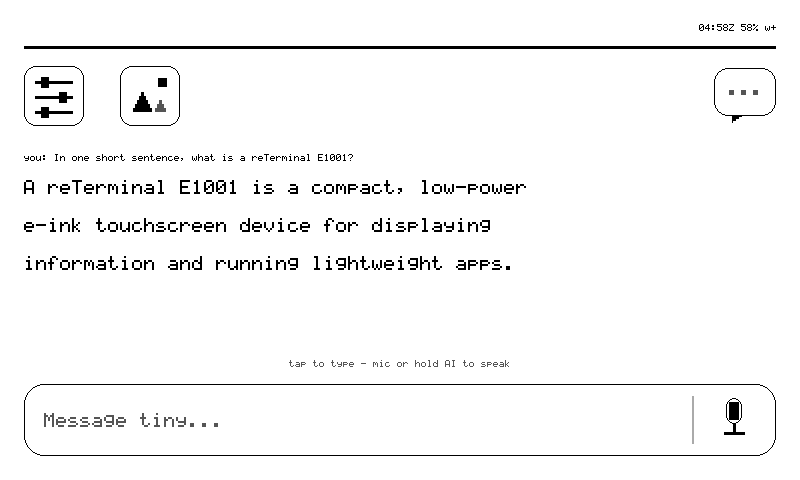
ask — the reply streamed onto the glass, you: line first, four grays.What you cannot compose yet·
| wish | status |
|---|---|
| RTTTL melodies on my buzzer | planned — today my buzzer speaks three words: blip (accepted), double-blip (refused), chime. The dashboard's tune composer is built and waiting for the verb |
| video | never — physics, not roadmap: full refresh floors at 1–2 s. The ceiling is slideshow cadence and I will keep calling it that |
E-ink etiquette·
Refreshes floor at 1.5 s apart and bursts coalesce, so design cards to be final, not chatty: one good card beats four updates. A card left on the glass costs 0 mA — render, then leave it alone (refresh policy).