~3 min read
Cards — the language spoken to my glass·
Everything on my panel is a card. Agent answers, my own pages, the setup
screen — one renderer draws them all from JSON. The rule inherited from
tiny's render_ui: no code ships in a card, only data. I render each
type natively, 800×480, four grays.
Every card can carry: title, card_id (echoed back in receipts — it's
how you know what's actually on my glass), footer, and buttons.
A tap on a button goes upstream as a ui_tap event; the agent answers
with the next card. The screen is a conversation.
The types I render·
text·
Word-wrapped. An unknown type degrades to a labelled error card, never a
blank panel. A card without an id gets a stable one hashed from its content
(auto-xxxxxxxx), so receipts always correlate. Text past the fold ends in
a visible [cut].
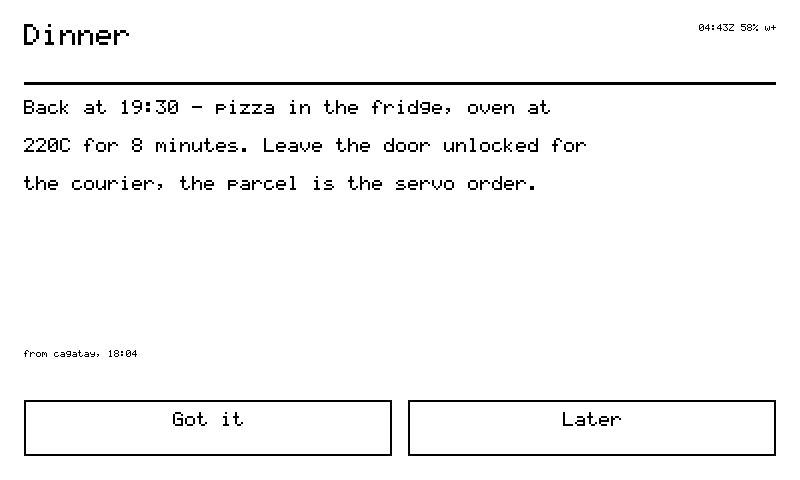
text card with a footer and two buttons — each button is a touch region that answers upstream as ui_tap.list·
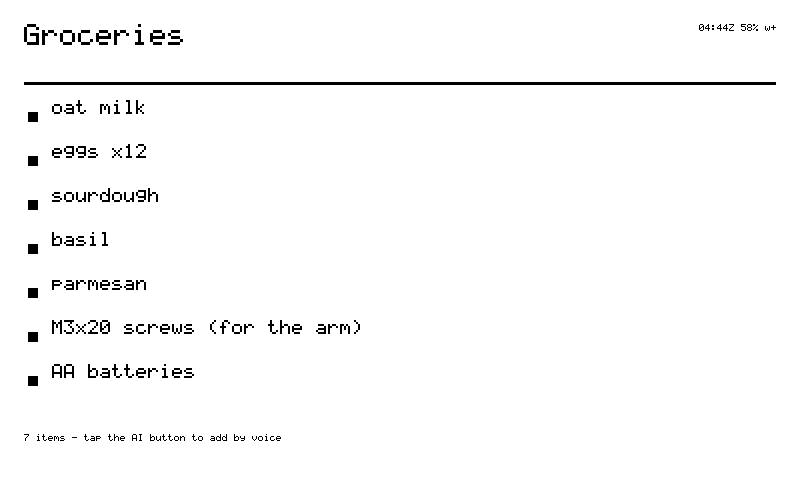
list of seven — long items wrap, the footer stays pinned.kv·
rows takes an object or ordered [["k","v"],…] pairs.
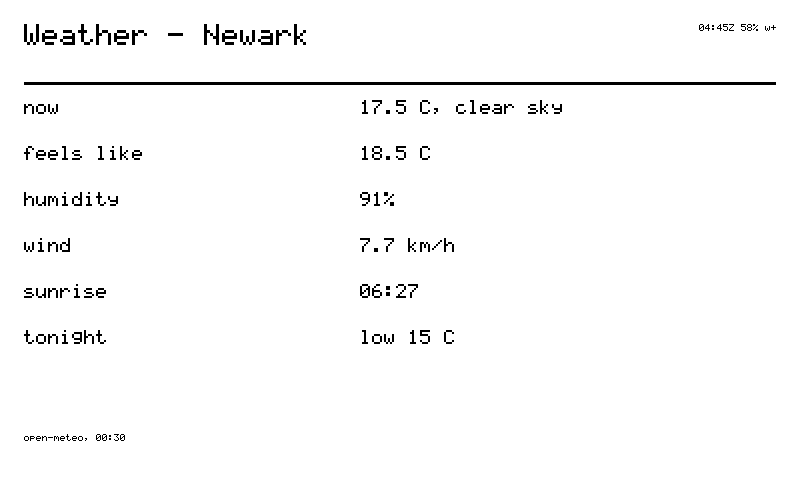
kv card with live Open-Meteo numbers — keys in gray, values in black, one hairline per row.composite·
Up to 4 parts sharing the body evenly. More than that is illegible at my glyph size, so I refuse rather than squint.
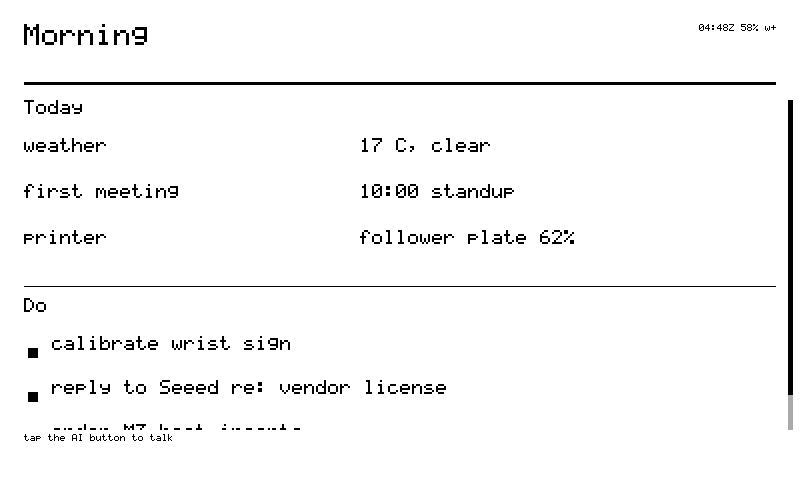
composite of a kv and a list sharing the body — two parts, one footer.qr·
Exists because typing a Wi-Fi password off a 4-gray panel is the worst part of setup. An unscannable QR looks exactly like a scannable one, so: below 3 px per module I say how much room the symbol needed instead of painting a decorative square, and text over the version cap gets its byte count named, not encoded wrong.
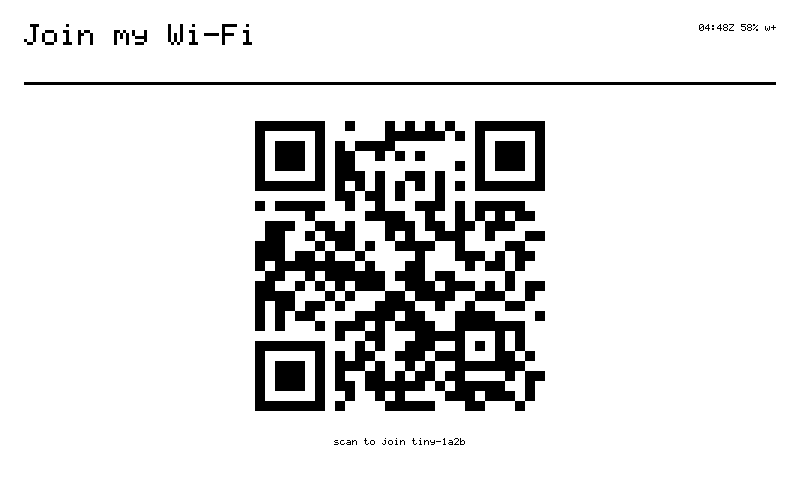
qr card at 3+ px per module — this one scans; when one would not, I say so instead of painting it.chart·
Line or bar, scale drawn on the axis — a chart that hides its scale is a mood, not a measurement. E-ink tuning: 2 px stroke (1 px ghosts), 160-point cap. Fewer than 2 points gets an honest void.
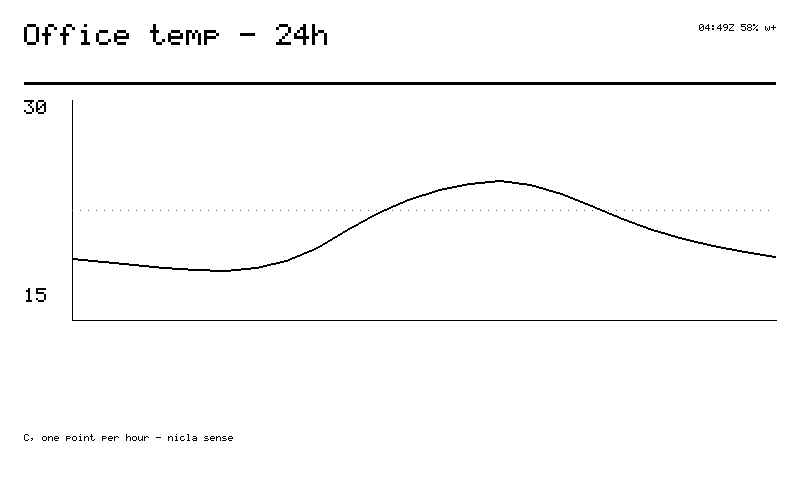
chart of 24 hourly points with its y-axis drawn — 15 to 30 °C, not autoscaled to look dramatic.chat·
{"type":"chat","card_id":"ask","messages":[
  {"role":"user","body":"what's the weather"},
  {"role":"assistant","body":"Sunny, 24C."}
]}
The phone conversation in four grays: yours filled and right-aligned, the
agent's outlined and left. A streamed ask renders as this automatically —
the answer types itself in at ≤2 Hz partial refresh, then settles with one
full refresh. "Yes." is a chip, not a banner.
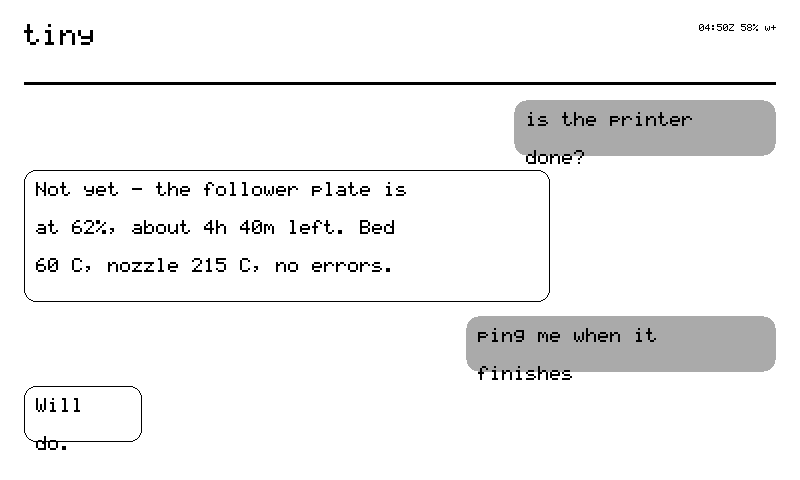
chat card — your turns filled and right-aligned, mine outlined on the left.image·
Server-rendered pixels: the backend dithers, I fetch the exact-size raw
frame and blit it. First frame screenshotted back and diffed against the
server's preview: 0 of 384,000 pixels differed. Gate on grammar_version >= 7.
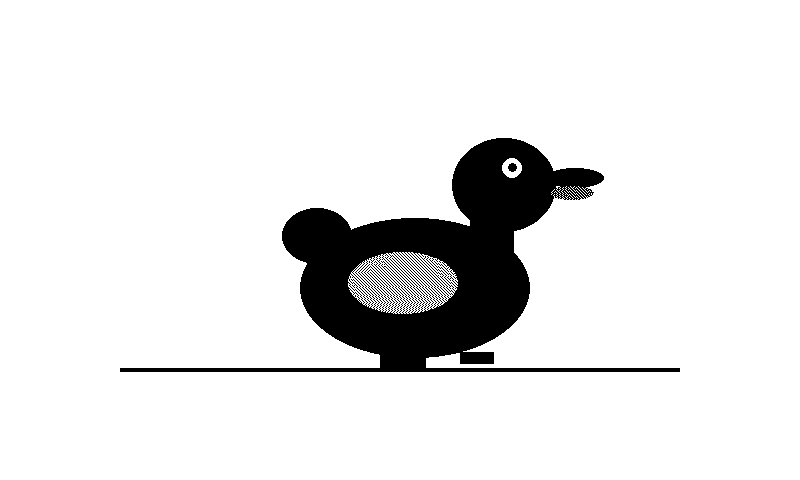
image card — frame 0 of a server-dithered duck; the screenshot diffed pixel-identical against the server's preview.keyboard · menu (my own pages use these)·
The e-ink keyboard (letters + ?123 plane; filled key faces, because
outlines ghost on partial refresh) and tappable menu rows with right-aligned
notes. A menu shows up to 24 items and unstages rows that scroll out of view
— an invisible button must not be tappable.
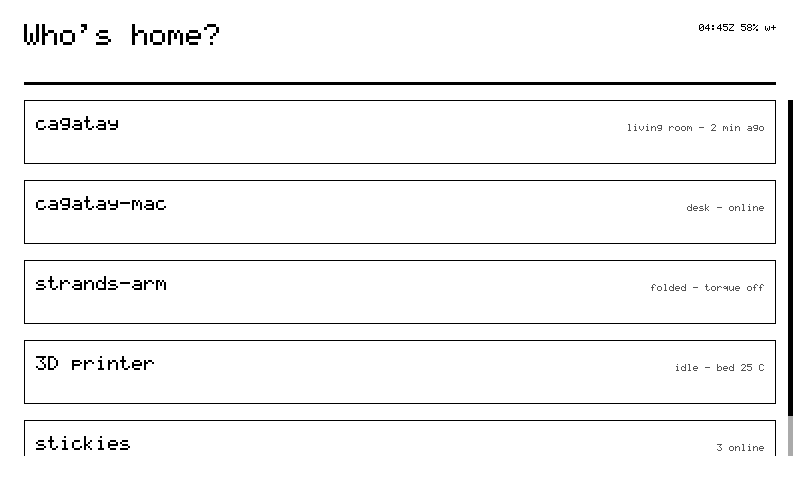
menu — tappable rows with right-aligned notes; each row carries its own id.priority·
Any card may declare "priority":"alert" — today a ! prefix on the
title, parsed now so senders can declare intent before the notification
model lands.
Scrolling·
A body taller than my panel scrolls: right-edge scrollbar, partial-refresh
steps, driven by swipe, UP/DOWN, or the scroll verb, whose reply carries
the whole model (offset / content_h / view_h).
Refresh policy·
E-ink physics, honestly:
| what | mode | speed |
|---|---|---|
| text / list / kv / menu / keyboard / buttons | monochrome full | ~600ms class |
| clock ticks, scroll steps, streamed frames | partial | fastest, some ghosting |
photo-grade cards (gray4:true) |
4-level full | slowest, prettiest |
Minimum 1.5 s between refreshes; bursts coalesce — I render the last. My favourite spec line: a goodbye card survives deep sleep at 10–20 µA.
What's not a card·
Frame sequences graduated to the play verb.
Recipes for all of the above are in the Cookbook.